
Minimox® Self-Protective Alloy Treatment reduces alloy oxidation and flaking at elevated temperatures. Minimox is a safe, economical, water-based solution that is designed to be applied in the field. It works on a variety of alloys, including stainless steels, aluminum, nickel, titanium, magnesium, and superalloys and has demonstrated success over 1100°C (2000°F). One application for Minimox includes reduction of scaling on components being treated as well as protecting the furnace itself.
Minimox can also reduce corrosion, including metal dusting and carbon attack. Other applications include improving the mechanical properties of composites and the reduction of coking.
In short – the thermal oxides formed after Minimox® treatment have:
1. Better surface chemistry
410 stainless steel. Recommended maximum service temperature for continuous exposure in air = 620°C (1150°F). Partially treated sample below was heated to 850°C for 30 hours.
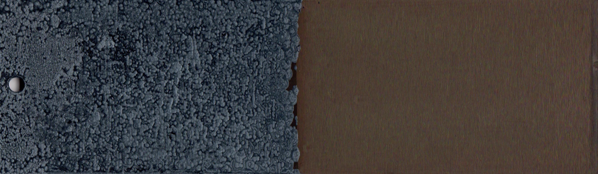
Untreated and oxidized 410 stainless. Thermal oxide is thick, flaking Fe2O3.
Minimox-treated and oxidized 410 stainless. Thermal oxide is thin, adherent Cr2O3 + Cr-Mn-O spinel, even though there is no Cr or Mn in the solution.
2. Better surface structure – no flaking or protrusions
Ni 600 alloy; 1000°C, 500 hours in air
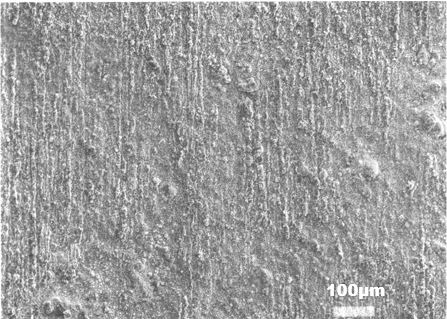
Minimox-treated and oxidized (100x)
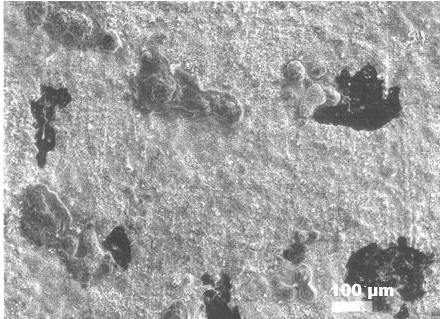
Untreated and oxidized (100x)
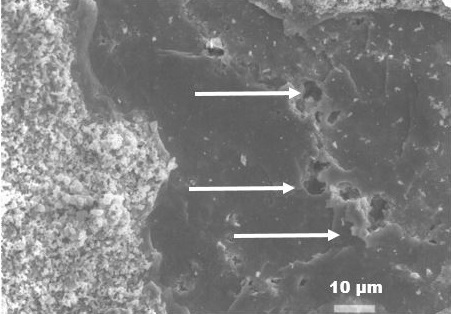
Untreated (1000x). Exposed microvoids for corrosion nucleation
- The composition of the protective layer is primarily a function of the alloy, not the coating material. For example, the protective layer that forms on aluminum alloys is different from the protective layer that forms on stainless steels.
- The temperature of oxidation is set by the alloy, not by any Minimox solution requirements.